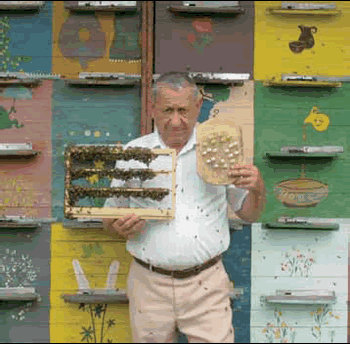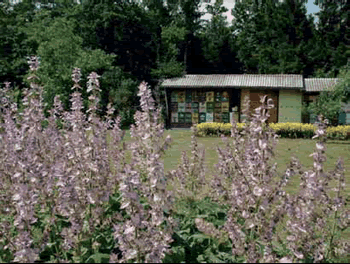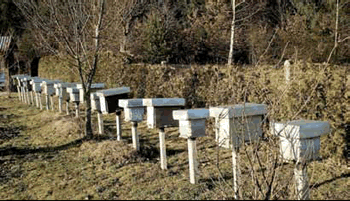
Our bee farm is located 1,500 meters north of the Celje-East freeway exit. The queen-rearing bee house with nucs stands at the edge of the forest along the road from Ljubečna to Vojnik and the rearing bee yard is located 6 km northeast of the Municipality of Vojnik. The area around the bee yard is quite hilly, so there is no intensive farming in the vicinity.
A special feature of our bee yard is the fact that it is in shade in the morning, so the colonies are without brood for nearly two months. However, in the rearing bee house the colonies are without brood for only a month, which also results in a smaller consumption of winter honey reserves. The spring loss of foragers due to hypothermia is smaller because the bees fly out of the hives in the shade a few hours later; thus, they are flying out to sunny hillsides that are already warm. In this bee yard, for a number of years our greatest attention has been devoted to the selection of parent colonies, which should contain bees with the best properties. The bees must not have yellow abdominal segments.
Over 300 queens are reared in a year. We have been rearing them for over ten years now. We use nucs composed of three or six compartments for mating and rearing queens; each compartment contains three frames one-third the size of an AŽ frame.
Approximately one liter of young bees is introduced into each nuc and fed with homemade bee candy.
Grafting larvae into queen cell cups is carried out in a heated room with warmed and partially diluted royal jelly. Queen cell cups are made of high-quality wax and are approximately half a millimeter larger in diameter than the plastic ones. When a young queen is hatched, there is still some royal jelly left at the bottom of the cell cup, showing that there is a sufficient amount of royal jelly. We then introduce ripe queen cells into the nucs using a cell-bar frame or introduce young queens using a queen cage. After the queen has mated, we examine the quality of the brood once again and number the queen.
Special attention is also paid to rearing drones from especially strong bee colonies. The entire drone brood is removed from the parent colonies, which prevents possible inbreeding.
We also make arrangements with nearby beekeepers to use our queens to avoid unwanted crossbreeding.
Because a two-story AŽ hive is slightly too small for a highquality queen, the queen is forced to lay eggs in the queen cells. To prevent swarming, we split the colony and remove the queen along with three combs of capped brood, and the bees.
In order to make a 7-frame back-up colony, we add one or two combs with bees, which are taken from a strong back-up colony.
We either leave the best queen cell in the split hive or remove all queen cells. After ten to twelve days, we examine the hive once again, destroy the emergency queen cells, and introduce a mated queen.