Bees have been my joy and hobby for 28 years now. Over the years, I have spent a lot of time in their company. I have observed their characteristics and reactions to specific situations, and I have also recorded all my findings. This is a valuable source of information about the development of each bee colony. Based on these findings, I selected only queens with a higher honey yield, with a reduced swarming impulse, that were calmer on the combs, and that stung less when they were being examined.
After this, I became increasingly interested in queen rearing, and so I began attending various lectures on queen rearing, and learned more by taking a seminar on queen rearing taught by Janez Poklukar and organized by the Agricultural Institute of Slovenia.
I enjoy both learning the theory and applying it in practice.
At first, I reared queens so I could expand my bee farm, as well as for my beekeeper friends. I received help and advice when I was getting started from a number of established and prominent breeders. In 1998, I satisfied all the requirements for joining the breeder’s group supervised by the Agricultural Institute of Slovenia.
Our queen-breeding station is among the youngest, but it is very active and high-quality. This year marks the tenth anniversary of our Carniolan queen rearing.
To find us, take the Ivančna Gorica exit towards Žužemberk from the Ljubljana–Novo Mesto freeway. Drive up the Krka Valley to the village of Fužina, where our bee farm is located.
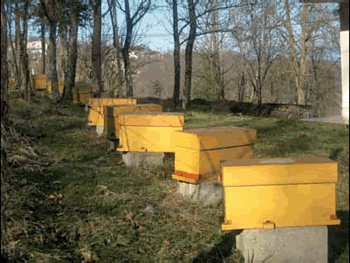
The breeding station is located in White Carniola in the small village of Kuželjevec, at an elevation of 450 meters. This is a hilly village above a spring feeding the Krka River, on the road from Zagradec to Ambrus.
The breeding station is in a small village in the middle of
a forest, in a pristine environment where there is no intensive farming and there are no farms to affect the environment. The environment where the rearing takes place is rich in pollen and nectar, which are key for the development of bee brood throughout the rearing season.
The number of queens reared and the demand for them is increasing from year to year. We rear between 600 and 900 mated queens a year. We also offer queen cells and virgin queens to beekeepers. Our buyers are beekeepers from Slovenia and abroad.
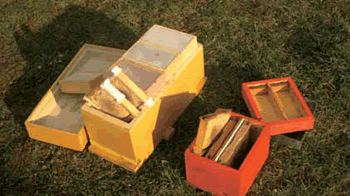
We use two types of nucs. The first are wooden nucs, made of two units in one piece, with opposite entrances and adjusted to fit one AŽ frame. The other type of nuc is made of polyurethane with entrances in all four directions. Their advantage is that they are warmer, and at the end of the rearing season we remove the division boards and use them to winter the back-up colonies; in the spring, we divide them into nucs again.
Based on our queen-rearing experience and extensive knowledge of our bees’ characteristics, we have achieved excellent results. Our bees produce great quantities of honey, their swarming impulse is reduced, they are calm on the combs, their spring development is intense, and the queens are large and racially pure.