I come from a beekeeping family. I celebrated my 50th anniversary of beekeeping as a member of the Radovljica Beekeepers’ Association – and I have had quite an interesting beekeeping career. I started keeping bees independently in 1957 with my father and brother’s help. In 1960, I became a member of the Radovljica Beekeepers’ Association. Between 1965 and 1970, I visited the beekeeping school in Graz on several occasions with my fellow townsman and the former president of the Slovenian Beekeepers’ Association, Valentin Benedičič. He was very familiar with the school in Graz and a great translator from German. In Graz, I learned more about bee diseases, such as nosema disease, varroatosis, bee lice, infectious diseases, and American foulbrood, as well as queen rearing (even in two-frame AŽ nucs), selection of the best colonies, swarm cells, superseded colonies, and the
round and jagged cuts of brood comb.
Between 1970 and 1985, I was the secretary of the Radovljica-Jesenice Beekeepers’ Association. As a delegate of the general board of the Slovenian Beekeepers’ Association in Ljubljana, I came into contact with Jože Rihar and Nežika Snoj, who proved to be of tremendous help to me as a bee-keeper. I was a supplier for the Hmezad company and later I was also the first president of the workers’ council of the Polhov Gradec Cooperative.
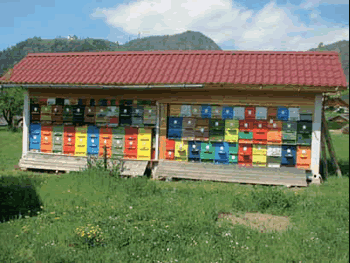
My bee farm soon grew to 100 AŽ hives and 50 backup colonies.
I sold my Carniolan colonies and queens (Alpine ecotype, Luznar line) all over Slovenia and all over the former Yugoslavia – mostly to Serbia, and some also to Austria and Germany.
Between 1985 and 2000, I kept bees and gained a lot of valuable experience. During this wonderful time I built myself a home in Begunje. My guide to success was literature. This period was certainly a turning point for all beekeepers because it was marked by the outbreak of varroatosis, which mercilessly wipes out apiaries, and the losses are therefore great. To fight this disease I used both natural, biological methods as well as chemicals.
After 2000, the situation in Slovenia changed significantly. We began receiving support from the European beekeeping funds and started increasingly harmonizing our regulations with European legislation. I acquired a national professional qualification and passed an exam as an inspector and instructor. I have a registered breeding station called the Radovljica Wooded Nature Trail. I have also received several commendations and awards for the queens I reared.